Items & recipes
Decide first: record compound, or only mats?
Pick your route before you set anything up, then build one flow and spend your time on BOMs.
Flow, BOM, formulation: which one do I create first?
Create the flow first. A BOM (your recipe) always lives inside a step of a flow; you create it in that step's Formulation tab.
1Decide first: what do you want to record?
Route A: I only want to record mats
Log finished mats. Trakto deducts the compound's raw materials by itself through the recipe. Least typing. Set up Route A →
Route B: I want to record compound too
Log every compound batch in kg, see compound in stock and on the floor, with batch numbers. Then log mats. More typing, more control. Set up Route B →
| Route A: only mats (phantom) | Route B: compound too (SFG) | |
|---|---|---|
| You log | Mats only | Each compound batch (kg), then mats |
| Raw materials | Deducted automatically from the mats | Deducted from each compound batch |
| Compound in stock | Never stocked: made and pressed the same shift | Counted in stock and on the floor, batch by batch |
| Accuracy | Recipe quantities; correct with Confirm materials or a stock count | Actual kg per batch, batch numbers and costs |
| Pros | Fast: one entry per run; nothing to forget | See compound on hand; trace a bad batch; compound targets |
| Cons | No compound stock figure | Two entries a day; a missed batch log throws stock off |
| Choose it if | Compound is mixed and pressed the same shift | You store compound, mix on another shift, sell it or test it |
Not sure? Start with Route A. You can add Route B later without losing anything. Both routes take several recipes: on the mat's flow for Route A, on the compound for Route B.
2Flow vs BOM
| Flow | BOM | |
|---|---|---|
| Answers | How is it made? | What goes in, and how much? |
| Gym mat example | Compounding → Pressing on Press 1 | Standard Compound: NR 20, SBR 20, clay 22 … per 100 kg |
| How many | Usually one | One per recipe you run |
| Changes | Rarely: a new machine or process | Often: a new grade, a cheaper filler, a customer spec |
Formulation is the tab of a step where its BOM is written. Loading weight is how much compound goes into one mat at the press; it is set on the pressing step.
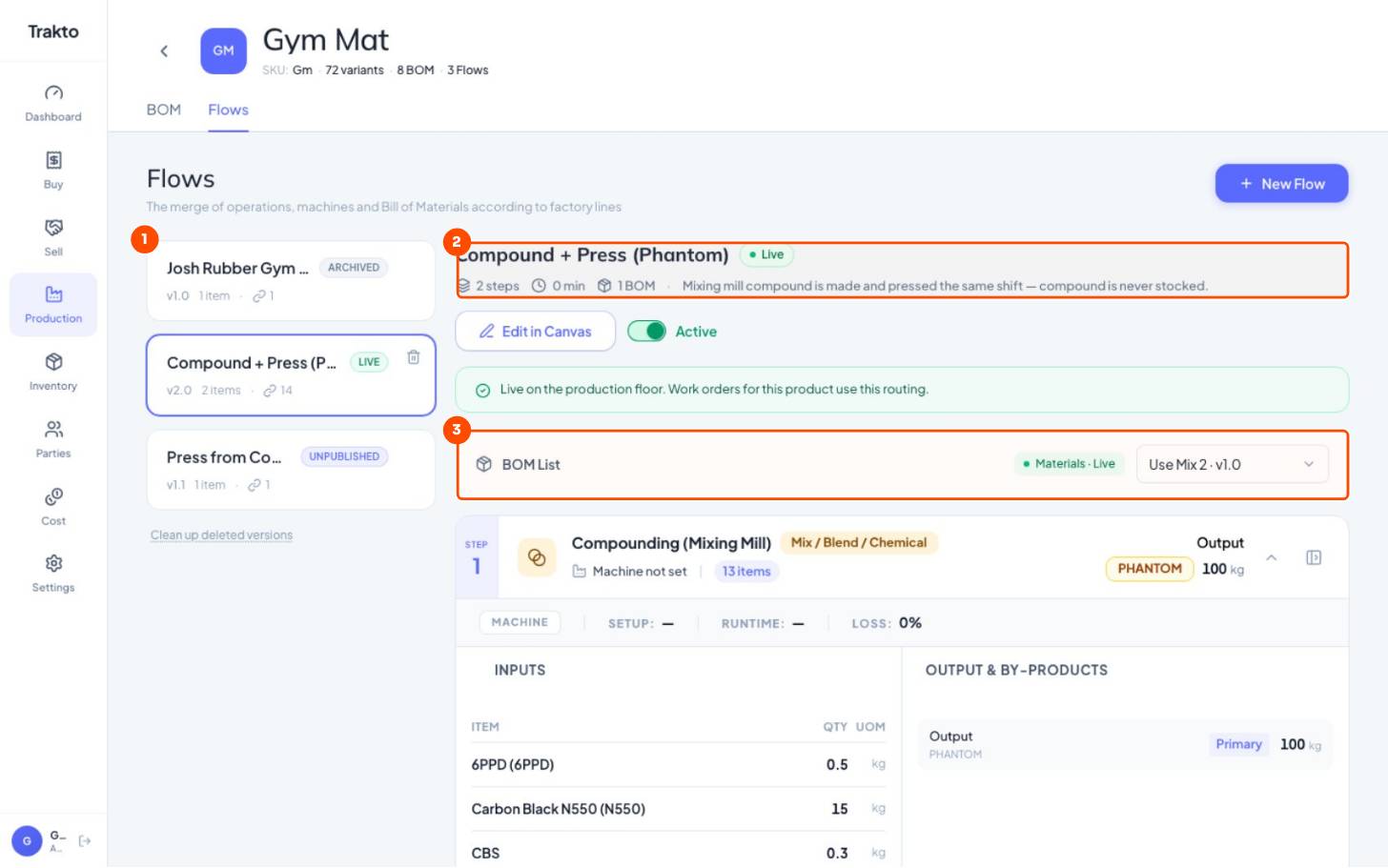
- 1Flows of this productUsually one. Only one is Live; others stay as drafts or archived.
- 2The live flowIts steps: Compounding → Pressing. Work orders and logs use it.
- 3Its BOMsThe recipes this flow can run. This is where most of your set-up work goes.
3Why more than one flow, or more than one BOM?
Another flow
Only for a genuinely different way of making: another line, a job worker doing a step, or compound bought in instead of mixed. One flow is live at a time.
Another BOM
Another recipe on the same flow: Standard, Economy, Premium, a softer mix for 18 mm. Limit it to certain SKUs, or pick it on a single log.
Rubber mat factories: build one flow, once. One or two steps (Compounding → Pressing) covers almost every moulding factory. Spend your effort on the BOMs: one per recipe you actually run. That is where your material cost and your quotes come from.
Still stuck?
Book a set-up call. We'll configure your compound, variants and machines with you.